ZIYAO LIN

Silhouettes of Time
The first part of the practice takes “imagined fossil evolution” as its guiding thread,
presenting the generation and dissolution of life forms within algorithmic processes.
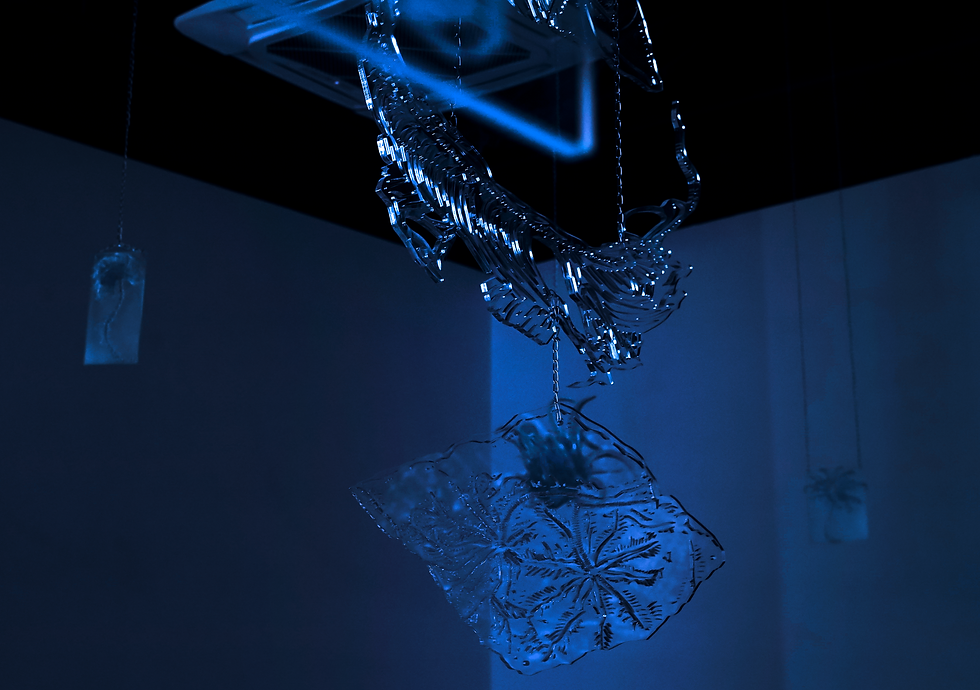
The second part consists of semi-transparent fossil models suspended in space,
derived from the forms of real fossils found in Guizhou, such as crinoids and Guizhouichthyosaurus, and abstracted into spatial “sedimentary objects.”
Starting from the geological formations and fossil assemblages of Guizhou,
the work constructs a poetic landscape concerned with geology and time.
On the theoretical level, the research is situated within a media studies framework.
It examines how contemporary image-generation technologies reorganise human visual imaginaries of the past through the processing of existing images and textual descriptions.


Research Background


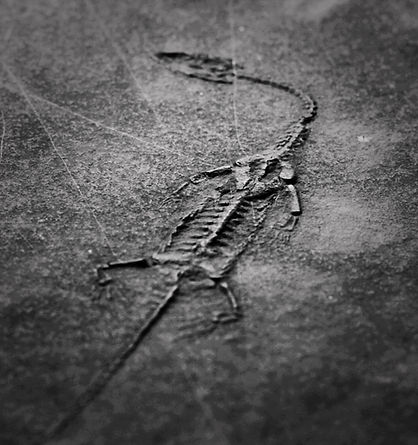
Guizhou is one of the most important fossil-bearing regions in China and globally. Its geological strata preserve a large number of biological remains from Mesozoic marine environments. These fossils not only record the forms of ancient life, but also retain layered information about time, environment, and evolutionary processes. Among the many fossil types found in the region, crinoids and Guizhouichthyosaurus are particularly representative.
They point to distinct modes of life structure and temporal scales, and together form a key entry point for understanding the ancient marine world of Guizhou. Crinoids are an ancient group of marine echinoderms that originated in the Ordovician period approximately 480 million years ago, more than 200 million years before the emergence of dinosaurs. They are among the earliest known groups of complex marine animals.
Although their appearance resembles that of plants, crinoids are animals whose bodies consist of a stalk, a calyx, and radially arranged arms.
These arms extend with ocean currents to filter-feed on plankton and suspended organic particles. Throughout geological history, crinoids were highly abundant, with several thousand fossil species documented. In some limestone strata, their remains even constitute major components, making them of significant importance in geological and paleoecological studies.
Crinoid fossils discovered in Guizhou are largely concentrated in the Middle Triassic period and are notable for their good preservation and morphological diversity. They provide crucial material for the study of Mesozoic marine ecosystems. While ancient crinoids were widely distributed in shallow marine environments, most extant crinoids today inhabit deeper waters. Their modes of attachment or fixation to the seafloor, often forming clustered assemblages, are frequently preserved in the fossil record as scenes resembling “underwater gardens,” becoming visible manifestations of time sedimented into space.
In contrast to the fixation-oriented life forms represented by crinoids, Guizhouichthyosaurus reflects a different evolutionary pathway marked by strong adaptation to marine environments. Guizhouichthyosaurus is an early marine reptile that lived during the Middle Triassic period, approximately 243–231 million years ago. Its fossils were first discovered in Guizhou in the 1950s, from which its name is derived. Belonging to the ichthyosaur lineage, Guizhouichthyosaurus exhibits a streamlined body structure that retains certain characteristics of terrestrial reptiles while demonstrating morphological adaptations to life in the ocean.
During the Triassic period, some reptiles that had previously lived on land or in coastal environments gradually returned to the sea. Over long evolutionary timescales, they developed body forms similar to those of fish or dolphins, giving rise to the ichthyosaurs as a major marine reptile group. As a representative organism of this evolutionary stage, the fossil morphology of Guizhouichthyosaurus records the transition from land to sea, while also preserving traces of movement, adaptation, and survival within ancient marine environments.
Material Exploration


The work employs acrylic and transparent resin as its primary materials.
The fossil patterns engraved on the transparent acrylic panels are derived from real fossil images, with lines extracted and translated from documented forms of ichthyosaurs and crinoids. These engraved elements retain a close correspondence to actual fossil morphology and function as references to scientific visual records.
In contrast, the three-dimensional forms produced in transparent resin incorporate speculative fossil shapes generated through AI-assisted processes. Rather than reproducing specific species, these resin models introduce imagined variations that extend beyond strictly accurate reconstruction.
Overview




Exhibition Space
The exhibition takes place at the art programme of Guizhou Bridge Museum, an education-oriented initiative that explores how knowledge of nature and geology can be communicated through artistic and technological means.


Project Overview Video

Projection Screenshots


Curator:
Iris Long
Project Support:
Guizhou Bridge Museum
Exhibition Photography:
Yichen Wei
Exhibition Technical Support:
Zhiyuan Gong
Acknowledgements
This project allowed me to engage with geological knowledge and to realise artistic ideas within a spatial context. I would like to thank curator Iris for supporting my exploration.